

All levels · 4 min read
Felting needles, explained
A barbed steel blade, a grip you can hold for hours, and a color you can grab in a second.
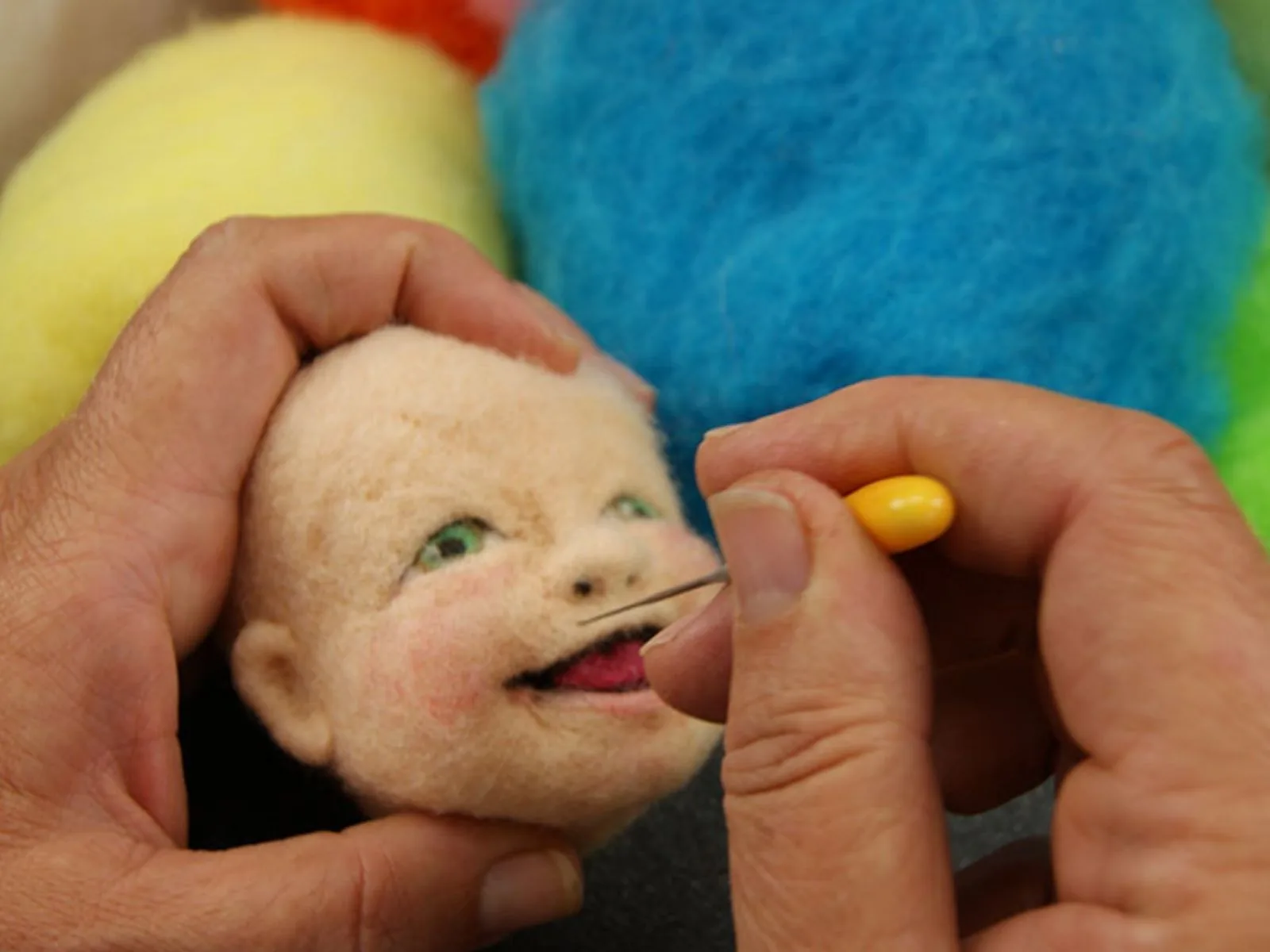
A felting needle is a barbed steel blade. The barbs catch wool fibers and tangle them so fluff becomes form. You poke — you do not sew, wet, or spin.
Most felting needles were designed for industrial machines. They all look alike. You’re not a machine. Felt Alive needles are Groz-Beckert blades in a cushioned, color-coded handle so you can felt for hours and still know which gauge is in your hand.
A grip you can hold for hours. A color you can grab in a second.
I designed these tools after years of needle felting dolls, faces, and teaching on camera. The handle is permanently affixed. The color is the gauge. Orange, yellow, red, black, blue, purple, and green — seven jobs, not a drawer of mystery blades.
Single, double, or quad
A single is one needle (details and dense wool). A double is two (faster shaping — I start nearly every project with a double yellow). A quad is four (large surfaces and flat work). Keep singles nearby as the wool firms; multiple blades get harder to pierce.
Where to begin
The Six-Pack is Felt Alive’s original product and a perfect place to begin. The color-code page tells you why each of the seven exists. Free video workshops use the same colors, so the tool in your hand matches the one on screen.
Questions felters ask
- What is a felting needle?
- A felting needle is a barbed steel blade. The barbs catch wool fibers and tangle them so fluff becomes form. You poke — you do not sew, wet, or spin. Felt Alive sets that blade in a cushioned, color-coded handle so you can hold it for hours.
- Why do Felt Alive needles have colored handles?
- Industrial felting needles all look alike. I color-coded seven gauges so you can pick the right tool at a glance — and so the colors match my free video workshops. Comfort is the grip. Color is convenience.
- Why only seven gauges?
- Groz-Beckert makes thousands of industrial specs. I use seven: the three my teacher named (fine, medium, coarse — yellow, red, and black) plus four jobs those three don’t cover. You don’t need a drawer of look-alike blades.
- Single, double, or quad — which do I need?
- A single is one needle in a handle (details and dense wool). A double is two (faster shaping). A quad is four (large surfaces and flat work). I start nearly every project with a double yellow, then switch to a single as the wool firms.
- Which pack should a beginner buy?
- The Six-Pack is Felt Alive’s original product and a perfect place to begin: one single-point needle in each of the seven colors, minus one — six tools, color-coded, with the grip you can hold for hours. The Studio Pack is the full studio in a box.
- Are Felt Alive needles Groz-Beckert?
- The blades are Groz-Beckert, made in Germany for mills. I set them in Felt Alive handles. You’re not a machine, so you get a cushioned grip — not a bare industrial shaft.